
Road speed & engine RPM reference
Compare engine RPM across road speeds using total reduction and nominal tire diameter. Change an input to explore the relationship.
Input parameters
Set your values below. The table updates automatically.
Comparison results
Overall reduction must include the selected transmission gear and any primary stage.
| Road speed (MPH) | Road speed (km/h) | Engine RPM |
|---|---|---|
| 20.00 | 32.19 | 795.09 |
| 30.00 | 48.28 | 1,192.63 |
| 40.00 | 64.37 | 1,590.18 |
| 50.00 | 80.47 | 1,987.72 |
| 60.00 | 96.56 | 2,385.27 |
| 70.00 | 112.65 | 2,782.81 |
| 80.00 | 128.75 | 3,180.36 |
How this table is calculated
engine RPM = road speed × 60 × overall reduction / circumferenceRows use the same assumptions while varying the value in the first column. Input-unit controls change the units used to enter values; column headers always state the output units.
How to read this comparison
Road speed varies while overall reduction and nominal tire diameter stay fixed. Overall reduction must already include primary drive and the selected transmission gear, when present.
A worked example with the initial inputs
At initial reduction 3.075:1 and 26-inch diameter, 60 MPH corresponds to approximately 2,385.27 engine rpm. Doubling the road speed would double RPM in the same fixed ratio and no-slip geometry.
The live table changes when you edit its controls.
Use the interactive calculator to explore more scenarios, units and relevant inputs.
Frequently asked questions
Can I enter only the rear axle ratio?
Only when it equals the complete engine-to-wheel reduction for the operating point. Otherwise multiply the axle ratio by the selected transmission and any primary or additional stage.
Why do input controls and column headers show different units?
The unit toggle changes how you enter dimensional inputs. Each output column keeps its stated unit so you can compare values consistently. Read the column header before copying a result.
Understand the method in more detail
 Motorcycle gearing and acceleration trade-offsA higher final reduction increases ideal rear-wheel torque at equal engine torque. Actual acceleration depends on engine RPM, traction, wheel lift and shift timing.How motorcycle gearing changes highway RPMAt a fixed road speed and tire circumference, engine RPM is proportional to overall reduction. Include the actual cruising transmission gear when comparing setups.
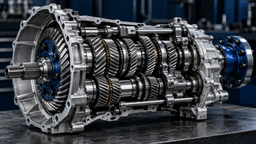 RPM to MPH: conversion with circumference and gearingRPM is rotational speed; MPH is distance per time. A conversion needs wheel travel per revolution and the reduction between the measured shaft and wheel.
Source and assumptions
Angular speed and tangential speed. Gear reductions follow tooth engagement and conservation of rotation count.
OpenStax — University Physics: rotation with constant angular accelerationRead the calculation methodology for model scope, unit conventions and review status.