
Derive it from a chord
For N equally spaced pin centers, each pitch is a chord subtending 2π/N radians at the center. Splitting the isosceles triangle gives pitch = diameter × sin(π/N), so pitch diameter is p/sin(π/N). This is regular-polygon geometry and does not specify the detailed tooth profile.
p = 2R sin(π/N) → D = p / sin(π/N)- p
- Nominal chain pitch between neighboring pin centers
- N
- Number of sprocket teeth
- R
- Pitch-circle radius; diameter D = 2R
Work through an example
With 12 teeth and 0.5-inch pitch, the half-angle is 15 degrees. Dividing 0.5 by sin(15°) gives approximately 1.93185 inches pitch diameter. The chain advances 6 inches per driver revolution, while π times this pitch diameter is slightly larger.
- Teeth / nominal pitch
- 12 / 0.5 in
- Half-angle / sine
- 15° / 0.258819…
- Pitch diameter
- 1.93185 in / 49.06903 mm
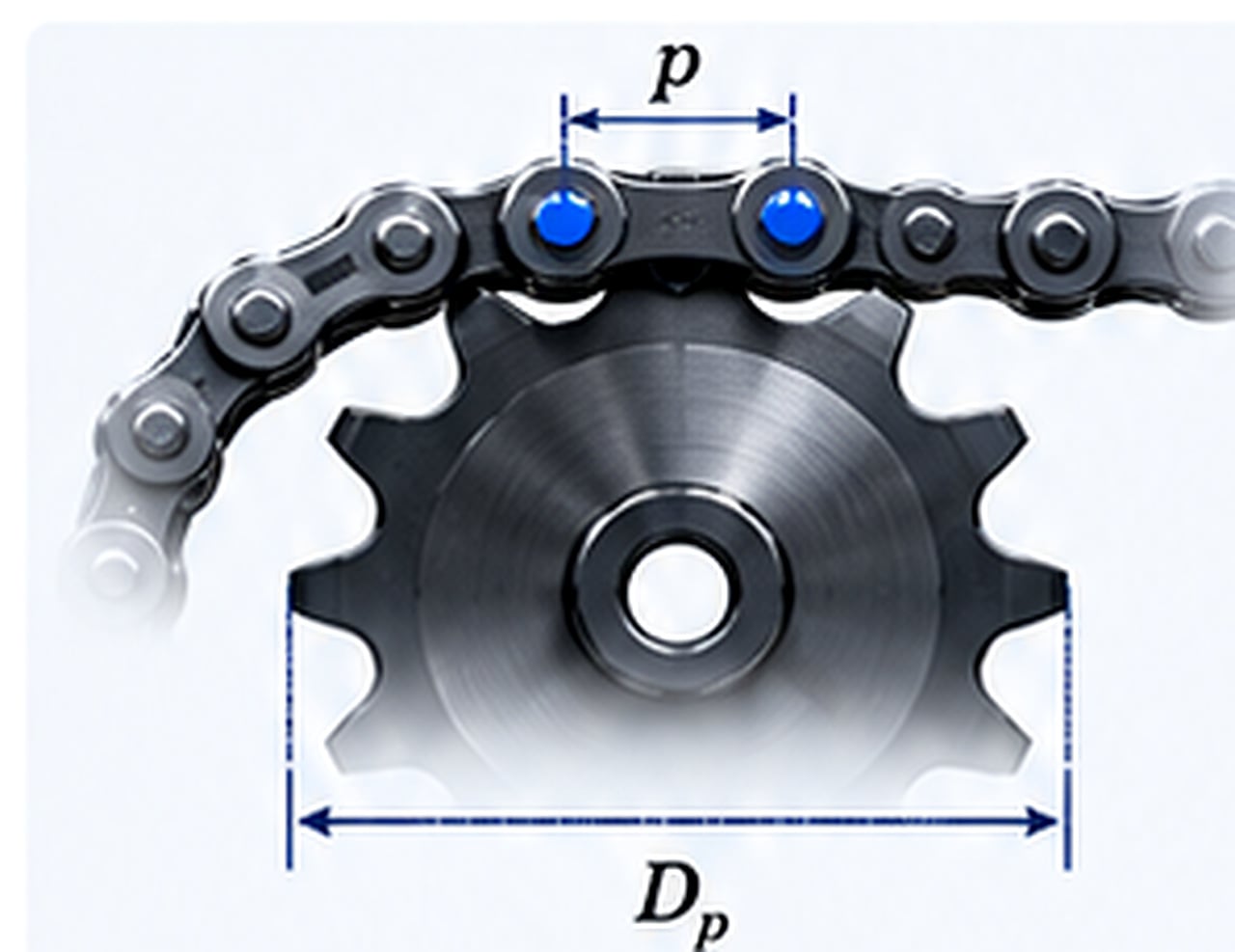
Pitch diameter, outside diameter and root diameter
A roller-chain sprocket has several useful diameters. Pitch diameter describes the circle through the nominal pin centers when the chain is seated. Outside diameter runs across the tooth tips, while root diameter describes the bottoms of the tooth spaces. These dimensions answer different questions; a caliper measurement over the teeth is not a measurement of the pitch circle.
For a sprocket pitch diameter calculation, you need the nominal chain pitch and the number of teeth. You do not need to measure the outside diameter first. The result helps compare sprocket geometry, but it does not define a complete tooth profile or the space required by the chain and guard.
Calculate sprocket pitch diameter step by step
Use D = p / sin(π / N), where D is pitch diameter, p is nominal chain pitch and N is the tooth count. The output has the same length unit as the pitch input.
D = p / sin(π / N) = p / sin(180° / N)- Count all the sprocket teeth and record N as a whole number.
- Identify nominal chain pitch from the chain specification. Enter 0.5 for a half-inch pitch, or 12.7 for the same pitch in millimeters.
- Divide 180 degrees by N, then take the sine of that angle in degree mode. In radian mode use π / N instead.
- Divide pitch by the sine. Round the final diameter for display, keeping the intermediate sine unrounded.
For the 12-tooth, 0.5-inch example, sin(15°) is approximately 0.258819. The diameter is 0.5 / 0.258819 = 1.931852 inches. Starting with 12.7 mm gives 49.069032 mm, which is the same physical diameter. Mixing degree and radian modes is a common reason for an unexpected result.
Pitch diameter chart for half-inch chain pitch
Hold pitch at 0.5 inch (12.7 mm) to isolate the effect of tooth count. These are geometric pitch diameters, rounded to three decimals; they are not outside diameters, manufacturing dimensions or a recommendation to use a particular tooth count.
| Teeth (N) | Pitch diameter (in) | Pitch diameter (mm) | Chain advance per turn (in) |
|---|---|---|---|
| 12 | 1.932 | 49.069 | 6.000 |
| 15 | 2.405 | 61.084 | 7.500 |
| 20 | 3.196 | 81.184 | 10.000 |
| 30 | 4.783 | 121.498 | 15.000 |
| 60 | 9.554 | 242.663 | 30.000 |
Changing from 12 to 20 teeth at the same pitch increases pitch diameter from about 1.932 to 3.196 inches. Doubling pitch while keeping the tooth count unchanged doubles pitch diameter exactly. Doubling tooth count makes the diameter approximately twice as large, but not exactly, because the sine term also changes.
Why chain travel is N × pitch rather than π × diameter
The chain wraps around the sprocket as a polygon: neighboring pin centers are joined by straight pitches. Each tooth advances one pitch, so one revolution advances N × p of chain. The circumference of the pitch circle follows arcs between those points and is slightly longer than the polygon perimeter.
For the 12-tooth, half-inch-pitch example, actual nominal advance is 12 × 0.5 = 6 inches per revolution. Multiplying π by the 1.931852-inch pitch diameter gives about 6.069 inches. Using that circumference as chain advance would overstate average chain speed by about 1.15%.
At 600 driver rpm, average chain speed is 6 × 600 = 3,600 inches per minute, or 1.524 m/s. A 60-tooth driven sprocket turns at 600 × 12 / 60 = 120 rpm. This average relationship does not describe the instantaneous speed variation associated with polygonal, or chordal, action.
Measure chain pitch and use the result correctly
Identify the chain from its markings and documented dimensions whenever possible. To check pitch with a ruler, measure between pin centers across several intervals and divide by the number of intervals. Eleven consecutive pin centers span ten pitches, not eleven.
For example, 5 inches across ten intervals corresponds to 0.5-inch pitch before accounting for wear and measurement uncertainty. A worn chain can measure longer than its nominal pitch, so measuring an old chain alone can misidentify the intended specification.
When estimating chain length for two sprockets, you also need shaft center distance and both tooth counts. When checking physical clearance, use the actual component envelope and manufacturer drawings. The pitch diameter formula by itself supplies neither of those checks.
Compare pitch-circle geometry with chain advance
The diameter formula locates pin centers, while travel per turn counts straight pitches. Both depend on tooth count, but they describe different geometry. Use the same nominal half-inch pitch in each calculation to isolate that distinction.
D = p/sin(π/N); nominal travel per turn = Np- Identify the nominal pitch and count actual teeth.
- Calculate pitch diameter using the sine half-angle in the correct angular mode.
- Calculate nominal chain advance separately as tooth count multiplied by pitch.
- Use manufacturer drawings for physical tooth-tip and clearance dimensions instead of treating the pitch circle as the component envelope.
| Teeth | Pitch diameter (in) | Nominal advance (in/rev) |
|---|---|---|
| 12 | 1.93185 | 6 |
| 20 | 3.19623 | 10 |
| 30 | 4.78339 | 15 |
The 20-tooth row has a pitch diameter of about 3.19623 inches and advances 10 inches of chain per turn. The pin-center circle is a useful mathematical reference, but the engaged chain consists of chords. That distinction is also why chain speed is calculated from Np rather than πD.
Check the inputs before interpreting a difference
If a measured outside diameter does not match this result, first confirm which diameter you measured. The model does not calculate tooth profile, bore, root diameter, wear or mounting tolerances.
Before you apply the result
Do not use the pitch circle as the required manufacturing blank diameter. Tooth form, roller seating, bore, clearance, material and tolerances require the correct engineering specification for the chain system.
Manufacturing
Pitch diameter does not define the blank or tooth-tip diameter.
Specifications
Match tooth form, roller dimensions, width and mounting.
Tolerances
Use the engineering specification for the exact chain system.
Applicability
The model describes pin-center geometry, not a complete tooth profile.
Try the calculation
Enter your own values in the related calculators. Compare one input at a time and keep units and operating conditions visible with the result.
Frequently asked questions
How do I calculate sprocket pitch diameter from chain pitch and teeth?
Divide nominal chain pitch by sin(180 degrees divided by the number of teeth). Use degree mode for 180/N, or radian mode for π/N. A 12-tooth sprocket with 0.5-inch pitch has a calculated pitch diameter of approximately 1.93185 inches.
Is pitch diameter the same as sprocket outside diameter?
No. Pitch diameter passes through the seated chain pin centers; outside diameter reaches the tooth tips. Tooth shape and chain dimensions are needed to determine the outside diameter. Do not add an assumed allowance to the pitch diameter for a manufacturing drawing.
Can I calculate pitch diameter in millimeters?
Yes. Enter pitch in millimeters and the result is in millimeters. Half an inch is exactly 12.7 mm. At 12 teeth, that gives approximately 49.069 mm. Tooth count and the sine term have no length unit.
What is the pitch diameter of a 20-tooth sprocket with half-inch pitch?
It is 0.5 / sin(9°), approximately 3.19623 inches or 81.18416 mm. The chain advances 10 inches per revolution. Those numbers do not specify the tooth-tip diameter, bore or chain width.
Can I identify a compatible chain from pitch diameter alone?
No. Even matching nominal pitch does not establish compatibility. Roller diameter, internal width, sprocket tooth form and other component specifications must match the intended chain system. Use the documentation for the actual parts.
Why does π times pitch diameter give a different chain speed?
πD is the circumference of a circle. A seated chain follows chords between pin centers, so nominal travel per turn is tooth count multiplied by pitch. The difference is proportionally more noticeable at smaller tooth counts.
Does a larger pitch diameter automatically give more speed?
At the same driver RPM and chain pitch, increasing driver teeth increases average chain speed. Driven-shaft speed still depends on both sprocket tooth counts. Increasing both counts in the same proportion preserves the shaft-speed ratio, even though both sprockets become larger.
Can I scale a sprocket pitch diameter to another chain pitch?
At the same tooth count, diameter is directly proportional to nominal pitch. Doubling pitch doubles the calculated pitch diameter. This scaling alone does not establish compatible tooth profiles or interchangeable parts.
Reference and method
Two-sprocket chain approximation and even-pitch selection. Sprocket geometry is independently derived from the regular polygon chord.
Renold — Transmission chain installation & designer guide ↗These explanations and examples describe the documented model. No manufacturer testing, named expert authorship or independent professional review is claimed. Read the method policy or report a correction.