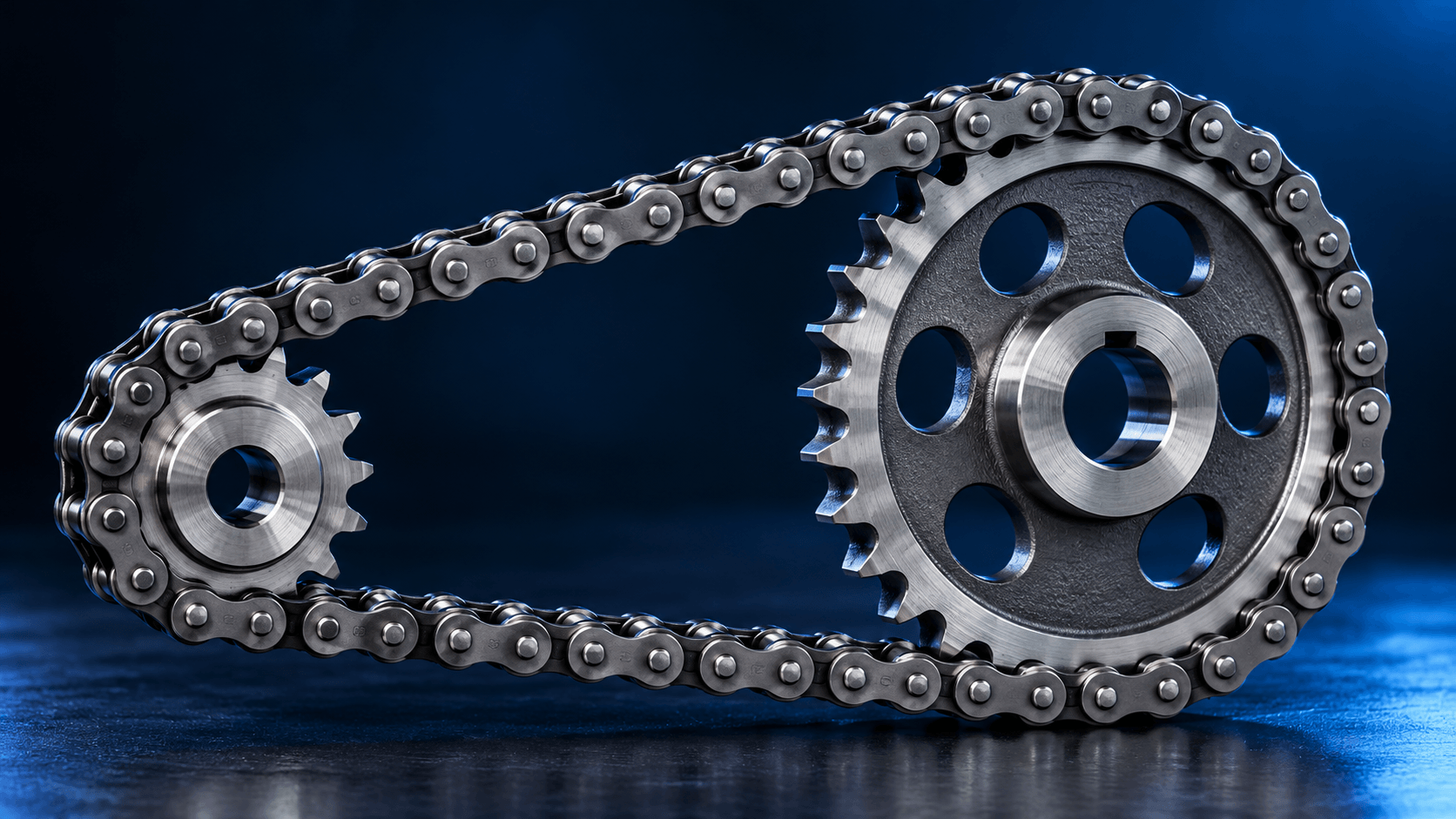
Calculate distance advanced per turn
Multiply chain pitch by driving teeth for travel per revolution, then by driver revolutions per second. The driven sprocket must pass the same pitches, so driven RPM equals driver RPM multiplied by driving teeth divided by driven teeth. Keep average travel separate from the instantaneous variations caused by chordal action.
Average chain speed = pitch × driver teeth × driver RPM/60Follow the worked comparison below for the input units and assumptions.
Work through an example
At 0.5-inch pitch, 12 driving teeth and 600 rpm, average chain speed is 0.5 × 12 × 600 = 3,600 inches per minute, or 1.524 m/s. A 60-tooth driven sprocket turns at 120 rpm.
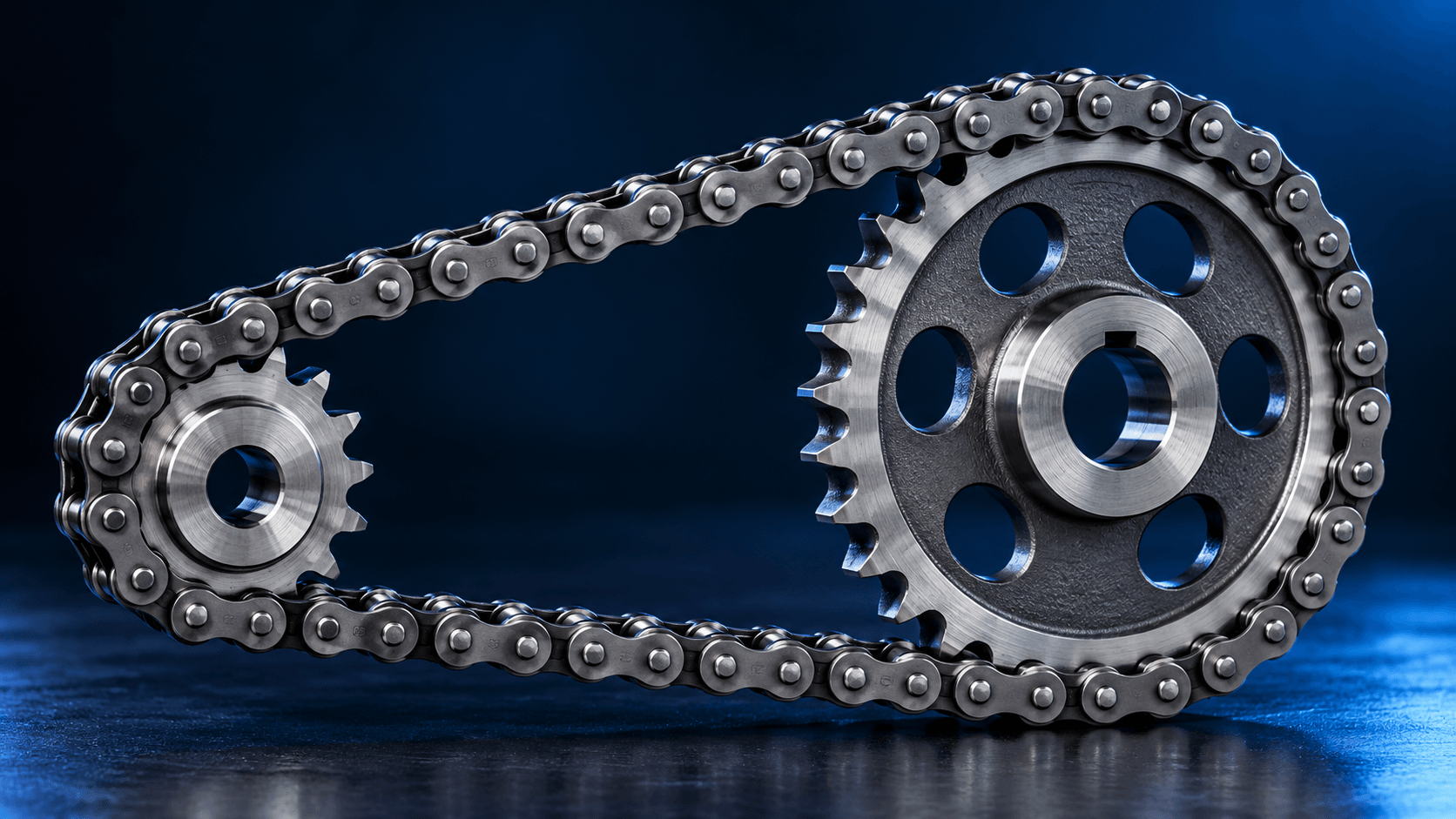
Calculate driven RPM from the same pitch flow
The number of pitches passing either sprocket per minute must match in an ideal engaged chain drive. Therefore driver RPM × driver teeth equals driven RPM × driven teeth. Chain pitch cancels from the speed ratio, but is still needed for linear chain speed.
Keep linear speed units visible
Pitch in inches multiplied by teeth and rpm gives inches per minute. Multiply by 0.0254 and divide by 60 to convert to meters per second. Do not substitute π times pitch diameter for tooth count times pitch: chain pin centers form a polygon.
Connect chain travel, driver RPM and driven RPM
Use half-inch pitch, a 12-tooth driver and a 60-tooth driven sprocket. Vary driver RPM to see both average linear chain speed and the driven shaft speed. The calculation assumes nominal tooth engagement and does not model slip or instantaneous chordal variation.
Average chain speed = pitch × driver teeth × driver RPM/60- Convert pitch to the desired length unit and identify the driving shaft.
- Multiply pitch by driver teeth for chain advance per revolution.
- Multiply advance by driver revolutions per second for average chain speed.
- Calculate driven RPM from driver RPM × driving teeth/driven teeth and compare both pitch-flow rates.
| Driver RPM | Driven RPM | Average chain speed (m/s) |
|---|---|---|
| 300 | 60 | 0.762 |
| 600 | 120 | 1.524 |
| 900 | 180 | 2.286 |
At 600 driver rpm, the nominal advance is 6 inches per turn and average chain speed is 1.524 m/s. The 60-tooth driven sprocket turns at 120 rpm. Increasing driver RPM scales both results proportionally while the tooth-count ratio remains fixed.
Check the inputs before interpreting a difference
Do not use circular pitch circumference as nominal chain advance or use the driven tooth count with the driving RPM. Confirm consistent pitch flow: driver teeth × driver RPM should equal driven teeth × driven RPM.
Before you apply the result
Speed alone does not establish a safe chain rating. Load, lubrication, alignment, number of teeth and operating conditions influence suitability. Use manufacturer selection data for power transmission and guard the actual chain system.
Try the calculation
Enter your own values in the related calculators. Compare one input at a time and keep units and operating conditions visible with the result.
Frequently asked questions
What is average chain speed from pitch and RPM?
Multiply nominal pitch by driver teeth and driver RPM. The length unit is the pitch unit per minute; convert it explicitly if needed.
Does chain length change the driven-shaft ratio?
Not in the ideal tooth-engaged relationship. Tooth counts set the shaft-speed ratio; length and center distance determine fit.
Does average chain speed establish a safe chain rating?
No. Manufacturer selection data must account for loading, lubrication, alignment and operating conditions.
Do both sprockets have the same chain speed?
The same engaged chain passes both sprockets, so their average pitch flow is equal in the ideal model. Their shaft RPM differs according to tooth counts; instantaneous chordal behavior is outside this average-speed calculation.
Reference and method
Two-sprocket chain approximation and even-pitch selection. Sprocket geometry is independently derived from the regular polygon chord.
Renold — Transmission chain installation & designer guide ↗These explanations and examples describe the documented model. No manufacturer testing, named expert authorship or independent professional review is claimed. Read the method policy or report a correction.